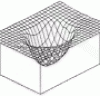
Groundwater Desktop (GWD) is a fully 3D interface for visualizing groundwater models and their results. While GWD is flexible and might be used to visualize any model, development to-date has focused on MODFLOW, MODPATH, and MT3D, including the latest unstructured grid capabilities within MODFLOW-USG. GWD enables users to view the model numerical grid, input data such as properties and boundary conditions, and output data including heads, concentration, and pathlines. Models can be examined using cross-sectional, cut-away, and layer "exploded" views.
Software
SSP&A has developed modeling and related software for over 20 years.
SSP&A develops and distributes software for groundwater modeling and related analyses. Many of these programs are provided free-of-charge, although a professional version of MT3D, referred to as MT3D99, is available. Select a software offering below to learn more.
mod-PATH3DU
S.S. Papadopulos and Associates. Inc., in collaboration with the University of Waterloo, has developed a powerful, state-of-the-art particle tracking software for groundwater models with unstructured grids. Armed with high-order Runge-Kutta ODE solvers and multi-threading support, mod-PATH3DU is the most powerful particle tracking program available for MODFLOW and MODFLOW-USG.
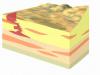
PEST
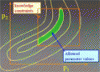
PEST - the world’s most advanced software for model calibration, parameter estimation and predictive uncertainty analysis. The days of manual model calibration and data interpretation are over.
SSM
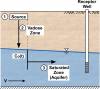
A Source Screening Module (SSM) has been developed in MS Excel to support preliminary evaluation of the threat posed by vadose zone waste sites on groundwater quality.
KT3D_H2O

KT3D_H2O Version 3.0 - A Program for Kriging Water Level Data using Hydrologic Drift Terms.
ATRANS
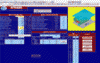
ATRANS A 3D analytical solution for transport from a patch boundary condition with time varying concentration.
BIOSCREEN-AT
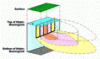
BIOSCREEN-AT is a screening-level model developed for and distributed by the EPA that simulates remediation through natural attenuation of dissolved hydrocarbons at petroleum fuel release sites.
Censored Multiple Regression (Tobit)
Many methods in common use to evaluate temporal trends in monitoring data rely upon univariate techniques that account for changes in measured concentrations by means of a single variable, namely time. The application of most temporal trend analysis methods in groundwater monitoring – such as parametric ordinary least squares (OLS) or the non-parametric Mann-Kendall test – time is usually the sole explanatory (or independent) variable and measurements of groundwater concentration provide the response (or dependent) variable.
CHUMP
TBD
MPNE1D
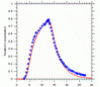
MPNE1D A General Analytical Solution for One-Dimensional Solute Transport. MPNE1D is a FORTRAN90 code that implements the general analytical solution for one-dimensional solute transport.
OneD
OneD - Excel implementation of analytical solutions for one-dimensional transport of solutes in groundwater.
Decay
DECAY is an analytical solution for one-dimensional transport of multiple species along a decay chain with branching. The treatment of branching accommodates species potentially having more than one parent and species having more than one daughter product. The DECAY solution considers advection, dispersion, equilibrium sorption, and first-order straight-chain and branching decay reactions. The species may have different dispersion and sorption coefficients. The solution accommodates the specification of different decay rates for the dissolved and sorbed phases for each species.
Open Excavation Flow Calculator
A set of steady-state analytical solutions of groundwater inflows to open excavations is assembled. The
solutions are appropriate for developing preliminary estimates of long-term rates of groundwater flows into
open excavations.
There are no closed-form analytical solutions for flow into rectangular excavations. Based on the work of Powrie and Preene (1992) approximate approaches for estimating the steady groundwater flow into rectangular excavations in confined aquifers are developed for three cases.